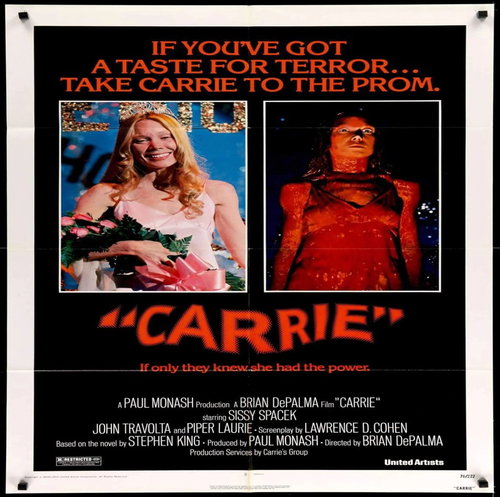


Brian De Palma’s Carrie, released in 1976, is a supernatural horror film adapted from Stephen King’s first published novel, Carrie (1974). Lawrence D. Cohen wrote the screenplay, and United Artists released the picture in the United States on November 3, 1976. The film centers on Carrie White, a painfully isolated high school student in the fictional Maine town of Chamberlain. At school, other girls ridicule her; at home, her mother Margaret imposes a violent, religiously extreme discipline. De Palma turns the story of humiliation and revenge into a stylized tragedy, rather than treating Carrie’s telekinetic ability as a conventional heroic gift.
Sissy Spacek plays Carrie, after initially auditioning for the role of Sue Snell. Piper Laurie portrays Margaret, Carrie’s fanatically devout mother. Amy Irving plays Sue, who feels guilty after participating in the locker-room cruelty; William Katt is Tommy Ross, Sue’s boyfriend; and John Travolta appears as Billy Nolan, Chris Hargensen’s boyfriend. Nancy Allen plays Chris, the classmate who engineers the prom prank. Betty Buckley is gym teacher Miss Collins, while P.J. Soles plays Norma Watson and Priscilla Pointer plays Sue’s mother. The youthful cast includes several performers whose later careers became notably prominent in American film and television thereafter too.
Carrie begins with a shower-room incident after she experiences her first menstruation and panics; the girls taunt her by throwing tampons and sanitary pads. When a light bulb breaks amid her distress, the film signals the powers she does not yet understand. Sue later asks Tommy to take Carrie to the prom as an act of atonement. Chris and Billy secretly collect pig’s blood and arrange for a bucket above the stage. After Carrie and Tommy are named prom king and queen, the bucket is tipped over her. Believing the audience is laughing at her, Carrie uses telekinesis against them.
The prom sequence, staged with split-screen imagery and shifting camera perspectives, is among De Palma’s most recognized set pieces. Pino Donaggio composed the score, beginning a long collaboration with the director. Mario Tosi served as cinematographer, and Paul Hirsch edited the film. Carrie received Academy Award nominations for Best Actress for Spacek and Best Supporting Actress for Laurie. Its final scene reveals that Sue has dreamt of visiting Carrie’s grave: a bloodied hand bursts from the earth and grabs her. This closing shock was not in King’s novel, which instead uses a documentary-style mosaic of reports, letters, and testimony afterward.


Reactions
0
0 Comments
Be the first to comment