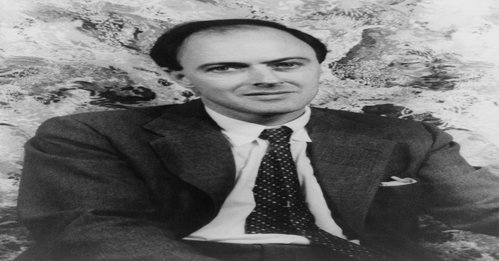


Roald Dahl was born in Llandaff, Cardiff, Wales, on 13 September 1916, to Norwegian parents Harald Dahl and Sofie Magdalene Hesselberg. He was named after polar explorer Roald Amundsen, whom his father admired. Dahl spent childhood summers in Norway and later drew on Norwegian folklore. Educated at St Peter's in Weston-super-Mare and Repton School, he did not attend university. In 1934, he joined the Shell Petroleum Company and was posted to East Africa. His early adulthood therefore supplied settings and details unlike those of a conventional literary apprenticeship. Those years later powerfully shaped his fiction and public identity for decades.
During Second World War, Dahl joined the Royal Air Force and trained as a pilot. In September 1940, his Gladiator crashed in the Libyan desert after he was directed to a location that proved wrong; he suffered serious injuries. He later flew Hurricanes with No. 80 Squadron in Greece and the Mediterranean. Medical problems ended his operational flying, and he was posted to Washington, D.C., as an assistant air attache. There he met writer C.S. Forester, who encouraged him to recount the crash. His account, published as "A Piece of Cake" in 1942, began his professional writing career in earnest.
Dahl developed a distinctive fantastical prose world of grotesque adults, endangered children, elaborate food, and sudden reversals. His 1961 novel James and the Giant Peach follows orphaned James Henry Trotter after magic crystals enlarge a peach; it carries him and insect companions across the Atlantic. Charlie and the Chocolate Factory (1964) introduces Charlie Bucket, Willy Wonka, and the golden tickets that admit children to Wonka's factory. Matilda (1988) pits a brilliant reader against the Wormwoods and headmistress Agatha Trunchbull, while The BFG (1982) pairs Sophie with a giant who secretly catches dreams and blows them into children's bedrooms at night.
Dahl also wrote adult fiction and screen work. His short stories often appeared in The New Yorker and were collected in volumes including Someone Like You (1953) and Kiss Kiss (1960). "The Landlady" and "Lamb to the Slaughter" show his taste for polished surfaces masking violence or menace. His screenplay for the 1971 film Willy Wonka and the Chocolate Factory adapted his own novel, although he publicly disliked aspects of the finished film. He married American actress Patricia Neal in 1953; they had five children and divorced in 1983. Dahl died in Oxford on 23 November 1990, aged seventy-four years.
반응
0
0 코멘트
첫 댓글을 남겨보세요
아직 아무것도 없습니다.
관련된 사람
사람
Eliza Capai
사람
Ridley Scott
사람
Denis Villeneuve
사람
Krysten Ritter
사람
Lee Byung-hun
사람
Han Ji-min
새 기사와 스포일러 알림을 받으시겠어요?