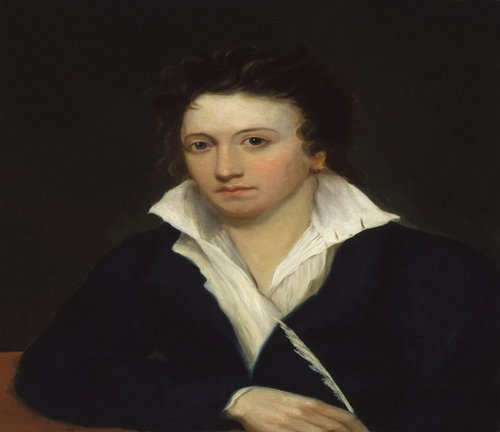


Percy Bysshe Shelley, born in 1792, was an English Romantic poet whose work connected political rebellion with intense natural imagery and philosophical speculation. He was born at Field Place near Horsham, Sussex, the eldest child of Sir Timothy Shelley, a Whig Member of Parliament, and Elizabeth Pilfold. At Eton College, he gained the nickname “Mad Shelley” and pursued chemistry, electricity, and controversial ideas. Expelled from University College, Oxford, in 1811 with Thomas Jefferson Hogg, he had circulated The Necessity of Atheism, a pamphlet challenging religious belief. Refusing to recant, he broke with his family’s expectations and began a life of
writing, exile, and unstable domestic arrangements. In August 1811, Shelley eloped to Edinburgh with Harriet Westbrook, then sixteen, the daughter of a London coffeehouse keeper. Their marriage deteriorated after Shelley met Mary Godwin in 1814. Mary, daughter of philosopher William Godwin and feminist writer Mary Wollstonecraft, travelled with Shelley through France, Switzerland, and Germany. In 1816, beside Lake Geneva, Shelley and Mary spent time with Lord Byron, John Polidori, and Claire Clairmont. That summer’s discussions of galvanism and ghost stories helped inspire Mary Shelley’s Frankenstein. Harriet drowned in December 1816; Shelley and Mary married shortly afterward amid familial crisis, pressure.
Shelley’s major poems emerged during his Italian years. In 1818, the couple left England and never returned; they lived in several Italian cities and endured the deaths of three children. His 1819 poem The Mask of Anarchy, written after the Peterloo Massacre, denounced state violence and urged resistance through the line “Ye are many; they are few.” In the same extraordinarily productive period, he wrote the “Ode to the West Wind,” “The Cloud,” and “To a Skylark.” Prometheus Unbound, published in 1820, recast Aeschylus’s myth as a drama in which Jupiter’s tyranny falls and Prometheus remains unconquered, morally and politically.
His final major poems included Epipsychidion, addressed to Emilia Viviani, and Adonais, an elegy for John Keats, who died in Rome in 1821. Shelley praised Keats as “a portion of the loveliness which once he made more lovely.” In 1822, Shelley, Byron, and Leigh Hunt launched The Liberal. On July 8, Shelley sailed from Livorno toward Lerici aboard the Ariel with Williams. Caught in a storm in the Gulf of Spezia, the vessel sank; Shelley, Edward Ellerker Williams, and boatman Charles Vivian drowned. His body washed ashore and was cremated near Viareggio. His ashes were buried in Rome’s Protestant Cemetery.
반응
0
0 코멘트
첫 댓글을 남겨보세요
아직 아무것도 없습니다.
관련된 사람
사람
Rachel Weisz
사람
Brendan Fraser
사람
Mike Leigh
사람
Sam Raimi
사람
Kate O'Flynn
사람
Laura Bailey
새 기사와 스포일러 알림을 받으시겠어요?