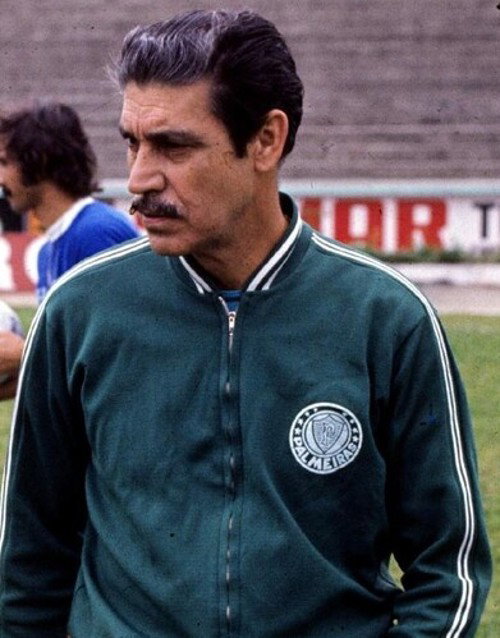


Oswaldo Brandão was a Brazilian football player and manager whose most important professional association was with Sociedade Esportiva Palmeiras. Born in Taquaritinga, in the state of São Paulo, on 18 January 1916, he became one of the central figures in Palmeiras history through a series of managerial spells that extended from the 1940s into the 1980s. He died in São Paulo on 3 July 1989.
Brandão had played for Palmeiras before establishing himself as a coach. His first tenure as the club’s manager began in 1945, and Palmeiras repeatedly returned to him over the following decades. That continuity produced an exceptional record in the Campeonato Paulista: teams led by Brandão won the state championship in 1947, 1950, 1959, 1963, 1966, and 1972. These victories span radically different periods of the club’s development, from the years immediately after World War II to the celebrated Palmeiras sides known as the Academia.
The 1950 Paulista title was particularly meaningful because Palmeiras had endured a difficult period after its 1942 name change from Palestra Itália, imposed amid Brazil’s wartime restrictions on references to Italy. Brandão’s championship team helped confirm the club’s recovery as Palmeiras. Later, his work was also connected to the team that became one of the dominant forces in Brazilian football during the 1960s and early 1970s. The 1972 Paulista title placed him alongside the generation that included players such as Ademir da Guia, a defining figure of the Academia era.
Brandão’s career was not restricted to Palmeiras. He managed major São Paulo clubs including Corinthians, Santos, and Portuguesa, as well as teams elsewhere in Brazil. At Corinthians, he is strongly associated with the 1977 Campeonato Paulista, a title of extraordinary symbolic weight for the club. Corinthians had not won the state championship since 1954, and the 1977 campaign ended that 22-year wait. The decisive phase included the celebrated final against Ponte Preta, and the championship became one of the most remembered achievements in Corinthians history.
He also worked with the Brazil national team during the 1970s. His career therefore linked several important institutions in Brazilian football, but Palmeiras remained the clearest measure of his influence. His six Paulista championships as Palmeiras coach made him one of the club’s most decorated managers. Rather than being identified with one brief golden season, Brandão’s significance rests on his capacity to lead successful teams across generations, adapt to changing squads, and remain a trusted figure whenever Palmeiras sought experience and authority on its bench.
反応
0
0 コメント
最初にコメントする
ここにはまだ何もありません。
関連している 人
人
Alejandro G. Iñárritu
人
Peter Safran
人
James Gunn
人
Agatha Christie
人
Danny McBride
人
Jessica Rothe
新しい記事やスポイラーの通知を受け取りますか?