À propos de Conscience collective
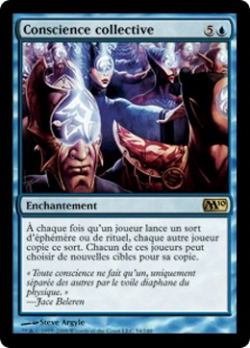
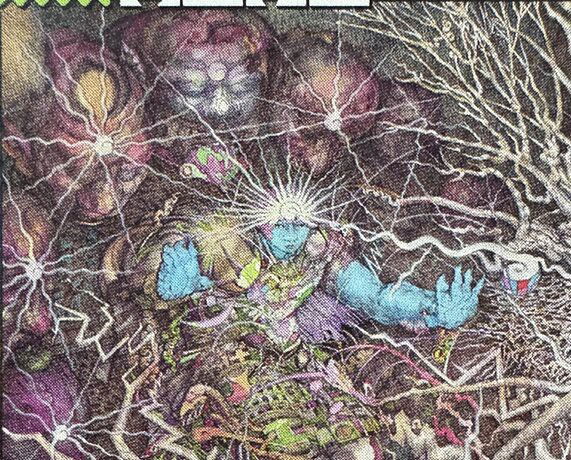
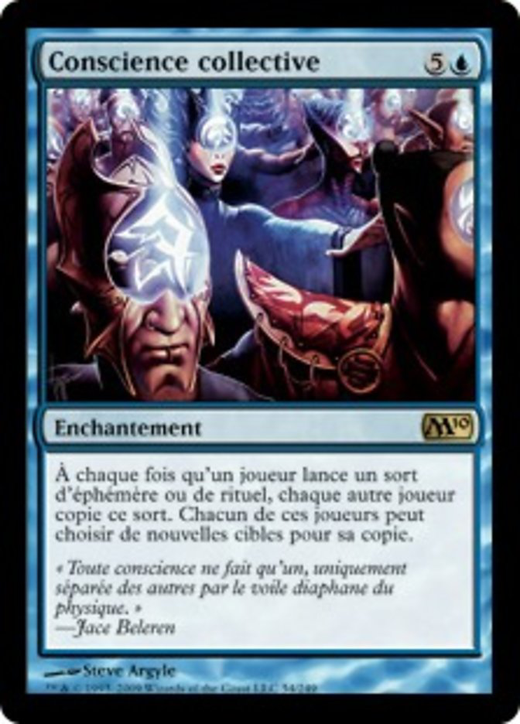
Conscience collective, Enchantement, conçu par Steve Argyle sorti pour la première fois en Jul, 2009 dans l'édition Magic 2010 et a été imprimé exactement dans 2 formes différentes. C'est une carte-clé dans 10 combos.
Un deck qui se concentre sur le lancement d'un grand nombre de sorts d'instantanés et de sorcellerie, comme un deck de contrôle ou de lancer de sorts, bénéficierait d'inclure Hive Mind. Cette carte peut créer des situations chaotiques et imprévisibles pour les adversaires, les forçant à réfléchir soigneusement à leurs choix de sorts et potentiellement à se retourner contre eux. Bien que Hive Mind puisse être une carte amusante et intéressante à jouer, certains pourraient soutenir qu'elle peut être un double tranchant en raison du potentiel de conséquences non intentionnelles. D'autres cartes similaires comme Eye of the Storm ou Knowledge Pool offrent des effets similaires mais avec des mécaniques différentes, donc le choix de la carte à inclure dépendrait de la stratégie spécifique et du style de jeu du deck.
Des règles
01/10/09
Each copy will have the same targets as the spell it’s copying unless its controller chooses new ones. That player may change any number of the targets, including all of them or none of them. If, for one of the targets, the player can’t choose a new legal target, then it remains unchanged (even if the current target is illegal).
01/10/09
Hive Mind’s effect is mandatory. Each other player must copy the spell whether they want to or not.
01/10/09
If a copy says that it affects “you,” it affects the controller of the copy, not the controller of the original spell. Similarly, if a copy says that it affects an “opponent,” it affects an opponent of the copy’s controller, not an opponent of the original spell’s controller.
01/10/09
If a player casts an instant or sorcery spell, Hive Mind’s ability triggers and is put on the stack on top of that spell. Hive Mind’s ability will resolve first. When it does, it creates a number of copies of that spell equal to the number of players in the game minus one. First the player whose turn it is (or, if that’s the player who cast the original spell, the player to that player’s left) puts their copy on the stack, choosing new targets for it if they like. Then each other player in turn order does the same. The last copy put on the stack will be the first one that resolves. (Note that the very last thing to happen is that the original spell resolves.)
01/10/09
If the spell that’s copied has an X whose value was determined as it was cast (like Earthquake does), the copy has the same value of X.









 download
 download





 Connectez-vous et rejoignez la conversation
— commentaires 0
, Réactions 1
Soyez le premier à commenter